UnlockingADHD

Empowering ADHDers and their Families to Live Life to the Fullest

UnlockingADHD

Empowering ADHDers and their Families to Live Life to the Fullest

  • English

  • About Us
    • Publications
    • About Us
    • Our Mission/Logo
    • Our Board of Directors
    • Scientific and Medical Advisory Committee (SMAC)
    • Our Team
    • Media coverage
  • Understanding ADHD
    • What is ADHD?
    • Who should I see?
    • Should I get assessed?
    • Diagnosis / Assessments
    • Medication
    • Natural ADHD Remedies
    • Other Treatment Options
    • ADHD Comorbidities
    • Health & Nutrition
    • Personal stories
  • Living with ADHD
    • Youth
      • ADHD in Teens
      • Careers
      • Executive Function
      • Personal Stories
      • School
    • Families
      • ADHD in Children
      • School
      • Parenting Approaches
      • Personal Stories
      • Self care
    • Adults
      • ADHD in Adults
      • ADHD in women
      • Executive Function
      • Personal Stories
      • Workplace Issues
    • Differently Wired Minds
      • The UnlockingADHD Team
      • The Creatives
      • The Entrepreneurs
      • The Social Warriors
      • The Guides
      • The Catalysts
  • ADHD Resources
    • Adult ADHD Self-Assessment Tool
    • Healthcare and Community Services
    • Seminar/Conference
    • Book Reviews
    • Other Resources
  • Get Involved
    • Volunteering
    • Events
    • Donations
    • Careers
  • Contact Us
    • Contact Us (Counselling Services)
    • Contact Us (General Enquiries)
  • Donate
ADHD in Teens, Executive Function, School

ADHD Study Struggles: Online Learning Edition

ADHD in Teens, Executive Function, School
July 11, 2021

Unlocking ADHD writer, Megan Tan, investigates the ups and downs of online school.
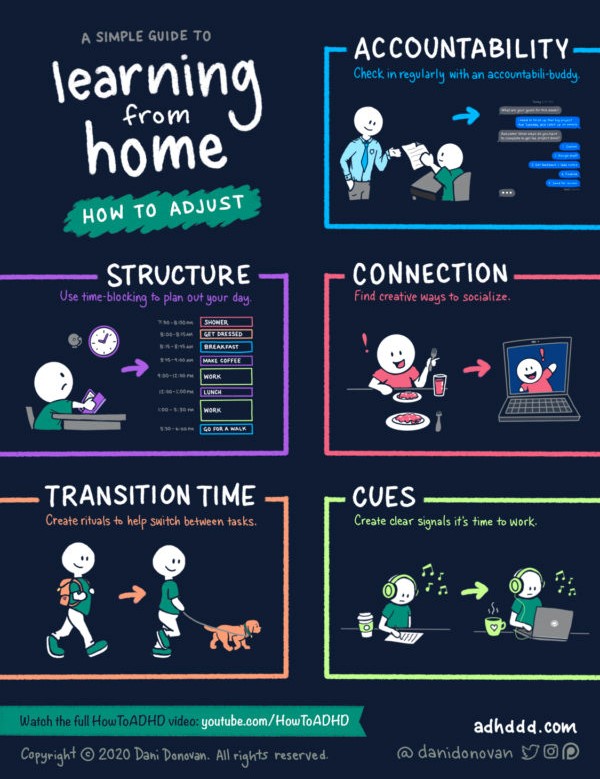
adjusting to online learning
Graphics: Dani Donovan

ADHD often means an individual’s ability to sustain attention, plan and organize is impaired. These functions are important in keeping up with and attending lessons. The COVID-19 pandemic has caused us to embrace online learning arrangements. How does online learning affect the ADHD brain?

The Pros and Cons of Online School

Studying at home means being able to accommodate some needs that will not be allowed in regular classes. For example, a person may potentially work best with music, but listening to music in class would not be allowed in school. At home, they would be able to listen to their music without being reprimanded.

However, being able to accommodate any and all of our needs quickly becomes an excuse. Maybe changing out of their pajamas is part of the daily routine for a student, but learning from home means this step now becomes optional. As a university student who just did (and is still doing) an entire year online, I found myself forgoing daily tasks such as eating regular meals or changing out of my bed clothes because it was no longer relevant to my routine, which also made studying difficult.

ADHDers are interest-based learners, so online learning gives us some agency. Online learning allowed me to pick which parts of a project or assignment interested me first. This allowed me to get started rather easily and that momentum carried me forward into other less interesting tasks.

However, since we are interest-based learners, sometimes we tend to forgo the boring parts of a task for more interesting things, and what could be more interesting than unlimited access to the internet? Now that we require internet use for online learning, it is extremely easy to also check YouTube, play online games or even access social media platforms rather than paying attention to the task at hand.

Being flexible with time is great, especially if it means you get to have that nice breakfast you dreamed of or catch up on sleep. However, ADHD also makes telling the passage of time difficult. In other words, we are a little “time blind”. This can be difficult with long-term assignments, or even homework, since we no longer have a set schedule to follow.

Help – What do I do?

As you can tell, there are clearly two sides to everything. How do we work around the cons?

  • Try body doubling. I do this with a friend who also has ADHD. This technique, which gets its name from “body doubles” in the acting profession, involves getting things done with a friend. The friend can help to hold you accountable so you will not be distracted, and will gently remind you to stay on task when your attention strays. It is also a good time to get some socialization in!
  • Take a look at your cues. Every day, different parts of our schedule “cue” us into our day. It could be walking across campus, plugging in your headphones or going to a designated workspace. I implemented this by making sure I always changed out of pajamas before I worked, and only doing work in the study room as opposed to my bedroom.
  • Consider investing in a planner. I have found that seeing time pass visually makes it easier for my brain to understand how much time I actually have. Some people prefer digital planners, others bullet journals, or simply just a pen and paper. Your options are limitless!

ADHD could make studying difficult, and studying from home even harder. Forcing ourselves to work like neurotypicals will not make things easier. Instead, we can find methods that work for our ADHD brains and watch ourselves excel.

If you like this article and find it helpful, please share this with your networks. Do consider donating to support us in our mission to empower ADHDers and their families to live life to the fullest so that we can continue to create more content that informs and equips the ADHD community – Please Donate To Support UA.

*DISCLAIMER: This information is provided for educational purposes only and does not constitute medical advice. Should you suspect that you have ADHD, consider seeking the advice of a trained mental health professional with any questions you may have about your condition.

Subscribe to our newsletter

  1. Leveraging My ADHD Wiring to Change Society
  2. Workplace Accommodations: Six Ways to Support Employees with ADHD
  3. Channel News Asia – Expert Q & A (November 2021)

Resources on ADHD

  • Adult ADHD Self-Assessment Tool
  • Understanding ADHD
  • Healthcare and Community Services
  • Support Groups
  • Online Resources
  • Contact Us (General Enquiries)
  • Contact Us (Counselling Services)

Follow us

Copyright © 2026 · Unlocking ADHD Ltd. All rights reserved. Terms | Privacy policy
Unlocking ADHD Ltd does not provide medical advice, diagnosis, or treatment. The material on this web site is provided for educational purposes only.

We use cookies on our website to give you the most relevant experience by remembering your preferences and repeat visits. By clicking “Accept All”, you consent to the use of ALL the cookies. However, you may visit "Cookie Settings" to provide a controlled consent.
Cookie SettingsAccept All
Manage consent

Privacy Overview

This website uses cookies to improve your experience while you navigate through the website. Out of these, the cookies that are categorized as necessary are stored on your browser as they are essential for the working of basic functionalities of the website. We also use third-party cookies that help us analyze and understand how you use this website. These cookies will be stored in your browser only with your consent. You also have the option to opt-out of these cookies. But opting out of some of these cookies may affect your browsing experience.
Necessary
Always Enabled
Necessary cookies are absolutely essential for the website to function properly. These cookies ensure basic functionalities and security features of the website, anonymously.
CookieDurationDescription
cookielawinfo-checkbox-analytics11 monthsThis cookie is set by GDPR Cookie Consent plugin. The cookie is used to store the user consent for the cookies in the category "Analytics".
cookielawinfo-checkbox-functional11 monthsThe cookie is set by GDPR cookie consent to record the user consent for the cookies in the category "Functional".
cookielawinfo-checkbox-necessary11 monthsThis cookie is set by GDPR Cookie Consent plugin. The cookies is used to store the user consent for the cookies in the category "Necessary".
cookielawinfo-checkbox-others11 monthsThis cookie is set by GDPR Cookie Consent plugin. The cookie is used to store the user consent for the cookies in the category "Other.
cookielawinfo-checkbox-performance11 monthsThis cookie is set by GDPR Cookie Consent plugin. The cookie is used to store the user consent for the cookies in the category "Performance".
viewed_cookie_policy11 monthsThe cookie is set by the GDPR Cookie Consent plugin and is used to store whether or not user has consented to the use of cookies. It does not store any personal data.
Functional
Functional cookies help to perform certain functionalities like sharing the content of the website on social media platforms, collect feedbacks, and other third-party features.
Performance
Performance cookies are used to understand and analyze the key performance indexes of the website which helps in delivering a better user experience for the visitors.
Analytics
Analytical cookies are used to understand how visitors interact with the website. These cookies help provide information on metrics the number of visitors, bounce rate, traffic source, etc.
Advertisement
Advertisement cookies are used to provide visitors with relevant ads and marketing campaigns. These cookies track visitors across websites and collect information to provide customized ads.
Others
Other uncategorized cookies are those that are being analyzed and have not been classified into a category as yet.
SAVE & ACCEPT

Daniel

This image has an empty alt attribute; its file name is logo-2-1.png
AMKFSC Community Services has a Psychological Services Unit (PSU) which has a team of clinical and counselling psychologists for children/youth and their parents. Core services include psychoeducational assessments (5 to 16 years old) for ADHD and other learning disabilities. They also offer group and individual psychotherapy. They only provide services to residents in their constituency.

Fees are $70 per one hour session. Psychoeducational testing ranges between $750 to $1,120 depending on the tests required.

Email: psureferral@amkfsc.org.sg.

Moonlake is the Founder of Unlocking ADHD. A community builder and multi-hyphenate, she runs to fat burn so that she can enjoy food with family and friends. She is still working on strengthening the brakes for her ADHD wiring…