


Unlocking ADHD writer Sanju Prabhakar gives some pointers to students with ADHD on how to make the most of their university experience.
If you or someone you know has ADHD, studying – as tiresome as it already is – is increasingly laborious and burdensome. ADHD is not just being “unable to focus” as many presume, and its symptoms often impact students in a wide variety of ways.
For the majority of students with ADHD – myself included – studying something that isn’t an area of specific interest is utterly dreary and difficult. Most of the time, all our energy has to go into just finishing what we need to complete and finally move on, leaving it behind! Fully under strain doing their work and filled with relief once they’re done, students with ADHD don’t often get the chance to reflect on what might facilitate their academics and help them work to the best of their abilities.
ADHD Accommodations at University
Fortunately, the current increase in inclusivity of several societal domains includes that of education – a sector rapidly evolving to acknowledge, account and accommodate for differently-abled students.
Today, a number of students diagnosed with ADHD have shared the accommodations made for them by their educational institutions, and the ways in which they have benefitted.
1. Extra Time
Giving students with ADHD extra time on tests and examinations is a relatively common learning accomodation in most educational frameworks. Students with ADHD may often take a while to settle in and shift their focus onto their work during timed examinations, with which a little extra time can significantly help.
Amanda Liang, a student at an international school in Singapore, shares her thoughts in this regard; “I was diagnosed with ADHD at age 13, and I’ve always gotten 25% extra time on all my tests and exams. Of course, it takes me some time to actually get my head into the test or the paper that I’m working on, and the extra time helps with that. But also, I get super anxious when I’m doing tests, especially because students like me (with ADHD) are constantly reminded of the fact that we’re different or not ‘normal’. It’s really anxiety inducing, and I know a lot of other kids feel the same. The extra time allows us to take a breath and just chill instead of being thrown into something that’s hard enough”.
Amanda also asserts that the additional time provided allows for any ADHD medication, for students to take it, to take its full effect and allow students to perform at their best. “Extra time is a must”, she asserts “All kids with ADHD should have the right to extra time on their exams”.
2. In-School Therapy

Individuals with ADHD often exhibit symptoms of other mental health conditions, including anxiety and depression. Indeed, ADHD has been shown to be highly comorbid with the conditions mentioned above. The high-pressure atmosphere prevalent in many schools and universities can exacerbate these symptoms and render academics to be even more difficult. Thus, attending in – school counselling sessions can allow students with ADHD to address and process such symptoms they may experience.
Aaliyah Shah, a Singaporean university student with ADHD, notes; “Of course, the effectiveness of counselling is entirely dependent on each individual and will impact each person differently – having the option, however, is non-negotiable to me. External counselling services are so expensive, having the school provide it for us makes it so much easier to seek support when we need it. I’ve always felt studying to be so difficult my whole life, but I’ve been able to feel so much safer starting my studies in a university that provides this support for students like me”.
3. Mentorship Programmes
To clear up a common misconception: Mentorship programs are not at all like counselling. Mentorship programmes are a less common form of support for students with ADHD, and consist of a mentor (a senior individual with ADHD/having worked with students with ADHD) working with students one-to-one on their academic progress.
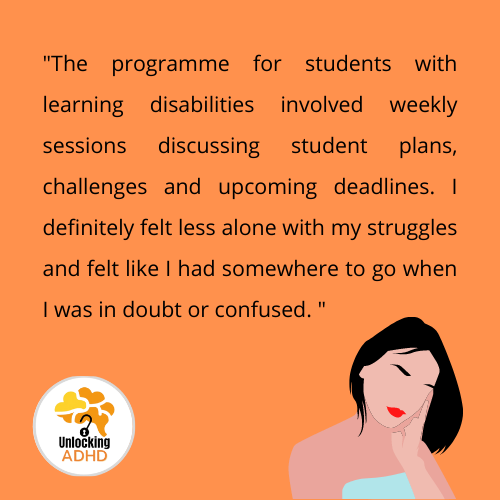
In fact, this was a programme sponsored by the university I attended in the UK for all students with learning disabilities. The programme varied from student to student, but involved weekly sessions discussing study plans, challenges and upcoming deadlines for me personally. I definitely felt less alone with my struggles and felt like I had somewhere to go when I was in doubt or confused (which was very often!).
4. Social Support Groups
Sometimes, just talking to people who understand us can be of immense help – and no less for students with ADHD. “It can be isolating to feel like you’re the only one with these problems. Even though you know others exist, it’s easy to feel like you’re all alone when you don’t even know these people”, exclaims Olivia White, a JC1 student diagnosed with ADHD. “My new school is great with these things. We have a group of students with different learning difficulties and mandated group meetings every month. We all complain and say we don’t feel like going, but becoming close with these people I know that we all really appreciate that we were able to find people who understand us and who we can relate to.
5. Personal Contact
Oftentimes, the best way to help an individual in any circumstance is just to ask them! This is especially applicable to supporting students with ADHD, because the reality is that there is no “one size fits all” way to support everyone.
Some students may just need extra time, some students may need additional mentoring and others may require something different altogether. Although official accommodations such as extra time may require official paperwork and other conditions fulfilled, it is quite simple to provide day-to-day support for students with ADHD based on what they require. Mathura Shankaran, a 15 year old student with ADHD, comments on this. “To be honest, the best year of school I ever had was when I was in Sec 2 and my teacher let me keep a fidget spinner in class. At the time, just having it with me was so helpful and I felt more at ease in the classroom. I have another friend with ADHD who got teachers to send her extra reminders about deadlines and homework to help her stay organised and on track. There are some small ways to help that can be done by anyone without a whole big process of visiting a thousand doctors and filling in a billion forms to submit. Just having people extend this support to you can make a huge difference in your life.”
These students have shared just five of the countless different ways you can support your friends and family studying with ADHD. If you would like to find out more about how to support your loved ones, do take a look at the other articles published on Unlocking ADHD (more info).
Raising awareness of the need for such support measures to be implemented is integral to helping all the students of today reach their full potential, as well as to have the best possible educational experiences! Please take a moment to share this article with anyone you feel may benefit from reading it, and make sure you keep a look out for more content from at Unlocking ADHD!


Leave a Reply