UnlockingADHD

Empowering ADHDers and their Families to Live Life to the Fullest

UnlockingADHD

Empowering ADHDers and their Families to Live Life to the Fullest

  • English

  • About Us
    • Publications
    • About Us
    • Our Mission/Logo
    • Our Board of Directors
    • Scientific and Medical Advisory Committee (SMAC)
    • Our Team
    • Media coverage
  • Understanding ADHD
    • What is ADHD?
    • Who should I see?
    • Should I get assessed?
    • Diagnosis / Assessments
    • Medication
    • Natural ADHD Remedies
    • Other Treatment Options
    • ADHD Comorbidities
    • Health & Nutrition
    • Personal stories
  • Living with ADHD
    • Youth
      • ADHD in Teens
      • Careers
      • Executive Function
      • Personal Stories
      • School
    • Families
      • ADHD in Children
      • School
      • Parenting Approaches
      • Personal Stories
      • Self care
    • Adults
      • ADHD in Adults
      • ADHD in women
      • Executive Function
      • Personal Stories
      • Workplace Issues
    • Differently Wired Minds
      • The UnlockingADHD Team
      • The Creatives
      • The Entrepreneurs
      • The Social Warriors
      • The Guides
      • The Catalysts
  • ADHD Resources
    • Adult ADHD Self-Assessment Tool
    • Healthcare and Community Services
    • Seminar/Conference
    • Book Reviews
    • Other Resources
  • Get Involved
    • Volunteering
    • Events
    • Donations
    • Careers
  • Contact Us
    • Contact Us (Counselling Services)
    • Contact Us (General Enquiries)
  • Donate
ADHD in Adults, Differently Wired Minds, Personal Stories, The Catalysts

ADHD Stories – Jerome J. Wong

ADHD in Adults, Differently Wired Minds, Personal Stories, The Catalysts
November 14, 2025

Loops, Not Lines

Jerome Wong is a law student, industrial design graduate, and author whose ADHD journey has shaped his creative process. From excelling in National Service to producing a thesis that will become a guidebook for parents of teens with ADHD, Jerome has discovered that his wiring is not a weakness but a source of strength and innovation.

Quotes

“Stop trying to think like everyone else. You’re not behind – you’re just wired to think in loops, not lines.”

“ADHD doesn’t make us less; it makes us different. And sometimes, that difference is what drives change.”

Early Signs

There wasn’t a single moment when ADHD revealed itself. It surfaced in fragments. As a child, I was fast—quick to learn, move, and react. Slowing down was the hard part. Teachers didn’t always know how to handle me. I did well enough but struggled to focus when the style of learning didn’t fit. Memorising facts for tests never stuck; I needed to know why they mattered.

I became a bit of a “jack-of-all-trades,” always chasing whatever sparked my curiosity. One moment I was racing down slopes as captain of Hong Kong’s national ski team; the next, I was exploring visual arts or diving into psychology. Along the way, I placed third in cross-country and javelin, constantly following novelty, stimulation, and instinct. To others, it looked unfocused. What they didn’t realise, and what I didn’t yet know, was that there was a name for how my brain worked.

National Service

In National Service, I was placed in a leadership role overseeing operations, welfare, and training. It was high-pressure, but I thrived. While others were still balancing demands, I was already three steps ahead. My ability to juggle moving parts, once seen as chaotic, became invaluable.

That was when I learned something important: the right environments allow traits to unfold without friction. I wasn’t aiming for recognition, but I was awarded the Sword of Honour, the highest cadet award. It wasn’t just about discipline or technical skill—it reflected systems awareness, emotional acuity, and adaptability. I now see those as core to how my ADHD brain works.

Finding My Fit in University
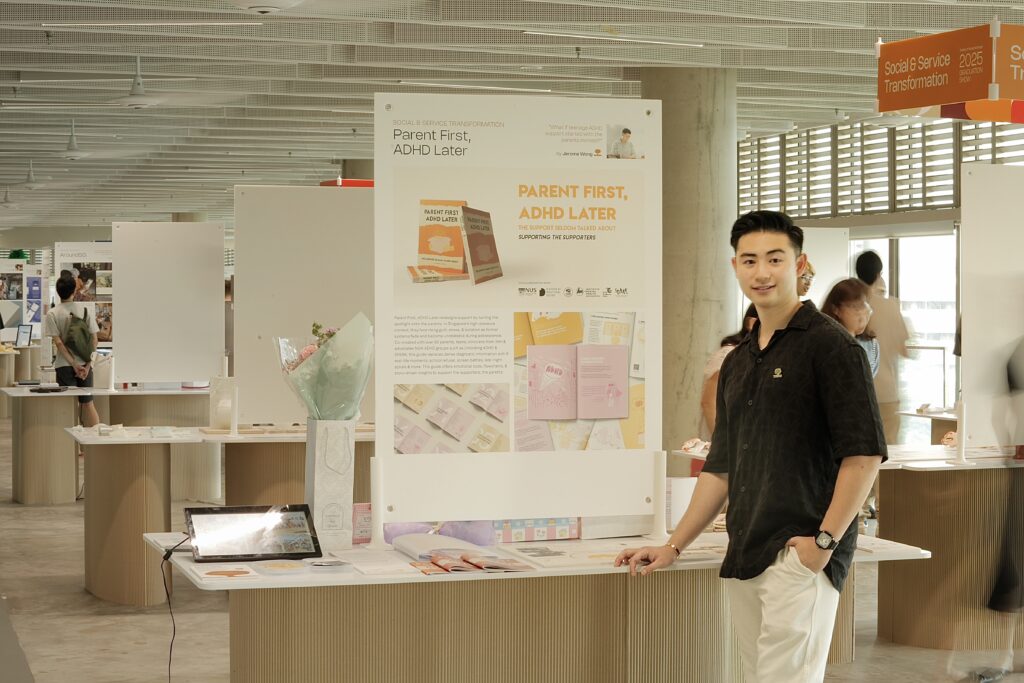
I entered university fearful. My past academic record was uneven, and I worried about repeating old struggles. But studying design changed everything. For the first time, I could shape how I worked. I was curious, engaged, and hyperfocus worked in my favour. I ended up at the top of my cohort—not by trying harder, but by finally caring deeply about what I was learning.

ADHD hadn’t stopped me; it enabled me to succeed once I stopped fighting my wiring. The lingering challenge was learning when to stop. When I’m engaged, I can go endlessly, not from pressure but from flow. I’ve had to teach myself that even excitement needs pacing.

Strategies That Work

I’ve learned to start small—sketch a mind map, do a five-minute trial, lower the stakes until I can begin. I think big-picture first, working from the outside in. It may look messy, but it’s how I understand. And I’ve learned to watch for my warning signs. If I feel myself spiraling, I pause and reset instead of pushing into burnout.

My Proudest Work

What I’m proudest of is my thesis: Parent First, ADHD Later—a guidebook for parents of teens with ADHD. It isn’t just clinical advice. It combines emotional clarity, visual tools, and real-world scenarios. I spoke with parents, teens, clinicians, and advocates, gathering a range of perspectives. Workshops helped me test and refine my ideas. Balancing the roles of researcher, designer, and community builder was exhilarating. Next, I’ll be collaborating with Unlocking ADHD to release the book in 2026.

The thesis earned the top score in my school, was recognised by the CEO of the Institute of Mental Health and is on track to be launched in 2026. ADHD helped me hold complexity without being overwhelmed. I could zoom out to see structure, zoom in to feel the tension, and transform the “mess” into clarity.

Looking Back

If I could talk to my younger self, I’d say: Stop trying to think like everyone else. You’re wired differently, and that’s your strength. You don’t have to prove yourself through exhaustion. Rest is part of your rhythm. Be kinder to yourself and trust that once you find your entry point, things will move fast.

I want the world to see ADHD not as something to manage, but as something to understand. Executive dysfunction isn’t carelessness—it’s often carrying more in your head than others can imagine. ADHD doesn’t make us less; it makes us different. And sometimes, that difference is what drives change.

Support the ADHD Community

If you’d like to read more stories like these, consider donating $150 or more to receive a copy of our book, Differently Wired Minds as a thank-you. Limited quantities available.

Your donation helps Unlocking ADHD provide counselling, psychoeducation, and other vital support services to those affected by ADHD.

Donation Link

Special thanks to our sponsors whose generous support made this book possible:

MINDSET, Singapore Pools, Chua Foundation, Hyphens Pharma

If you like this article and find it helpful, please share this with your networks. Do consider donating to support us in our mission to empower ADHDers and their families to live life to the fullest so that we can continue to create more content that informs and equips the ADHD community – Please Donate To Support UA.

*DISCLAIMER: This information is provided for educational purposes only and does not constitute medical advice. Should you suspect that you have ADHD, consider seeking the advice of a trained mental health professional with any questions you may have about your condition.

Subscribe to our newsletter

Leave a Reply Cancel reply

Your email address will not be published. Required fields are marked *

  • Rating

This site uses Akismet to reduce spam. Learn how your comment data is processed.

  1. ADHD Stories – Chua Ee Chien
  2. ADHD Stories – Carrie Tan
  3. ADHD Stories – Jeremy Sim

Resources on ADHD

  • Adult ADHD Self-Assessment Tool
  • Understanding ADHD
  • Healthcare and Community Services
  • Support Groups
  • Online Resources
  • Contact Us (General Enquiries)
  • Contact Us (Counselling Services)

Follow us

Copyright © 2026 · Unlocking ADHD Ltd. All rights reserved. Terms | Privacy policy
Unlocking ADHD Ltd does not provide medical advice, diagnosis, or treatment. The material on this web site is provided for educational purposes only.

We use cookies on our website to give you the most relevant experience by remembering your preferences and repeat visits. By clicking “Accept All”, you consent to the use of ALL the cookies. However, you may visit "Cookie Settings" to provide a controlled consent.
Cookie SettingsAccept All
Manage consent

Privacy Overview

This website uses cookies to improve your experience while you navigate through the website. Out of these, the cookies that are categorized as necessary are stored on your browser as they are essential for the working of basic functionalities of the website. We also use third-party cookies that help us analyze and understand how you use this website. These cookies will be stored in your browser only with your consent. You also have the option to opt-out of these cookies. But opting out of some of these cookies may affect your browsing experience.
Necessary
Always Enabled
Necessary cookies are absolutely essential for the website to function properly. These cookies ensure basic functionalities and security features of the website, anonymously.
CookieDurationDescription
cookielawinfo-checkbox-analytics11 monthsThis cookie is set by GDPR Cookie Consent plugin. The cookie is used to store the user consent for the cookies in the category "Analytics".
cookielawinfo-checkbox-functional11 monthsThe cookie is set by GDPR cookie consent to record the user consent for the cookies in the category "Functional".
cookielawinfo-checkbox-necessary11 monthsThis cookie is set by GDPR Cookie Consent plugin. The cookies is used to store the user consent for the cookies in the category "Necessary".
cookielawinfo-checkbox-others11 monthsThis cookie is set by GDPR Cookie Consent plugin. The cookie is used to store the user consent for the cookies in the category "Other.
cookielawinfo-checkbox-performance11 monthsThis cookie is set by GDPR Cookie Consent plugin. The cookie is used to store the user consent for the cookies in the category "Performance".
viewed_cookie_policy11 monthsThe cookie is set by the GDPR Cookie Consent plugin and is used to store whether or not user has consented to the use of cookies. It does not store any personal data.
Functional
Functional cookies help to perform certain functionalities like sharing the content of the website on social media platforms, collect feedbacks, and other third-party features.
Performance
Performance cookies are used to understand and analyze the key performance indexes of the website which helps in delivering a better user experience for the visitors.
Analytics
Analytical cookies are used to understand how visitors interact with the website. These cookies help provide information on metrics the number of visitors, bounce rate, traffic source, etc.
Advertisement
Advertisement cookies are used to provide visitors with relevant ads and marketing campaigns. These cookies track visitors across websites and collect information to provide customized ads.
Others
Other uncategorized cookies are those that are being analyzed and have not been classified into a category as yet.
SAVE & ACCEPT

Daniel

This image has an empty alt attribute; its file name is logo-2-1.png
AMKFSC Community Services has a Psychological Services Unit (PSU) which has a team of clinical and counselling psychologists for children/youth and their parents. Core services include psychoeducational assessments (5 to 16 years old) for ADHD and other learning disabilities. They also offer group and individual psychotherapy. They only provide services to residents in their constituency.

Fees are $70 per one hour session. Psychoeducational testing ranges between $750 to $1,120 depending on the tests required.

Email: psureferral@amkfsc.org.sg.

Moonlake is the Founder of Unlocking ADHD. A community builder and multi-hyphenate, she runs to fat burn so that she can enjoy food with family and friends. She is still working on strengthening the brakes for her ADHD wiring…