UnlockingADHD

Empowering ADHDers and their Families to Live Life to the Fullest

UnlockingADHD

Empowering ADHDers and their Families to Live Life to the Fullest

  • English

  • About Us
    • Publications
    • About Us
    • Our Mission/Logo
    • Our Board of Directors
    • Scientific and Medical Advisory Committee (SMAC)
    • Our Team
    • Media coverage
  • Understanding ADHD
    • What is ADHD?
    • Who should I see?
    • Should I get assessed?
    • Diagnosis / Assessments
    • Medication
    • Natural ADHD Remedies
    • Other Treatment Options
    • ADHD Comorbidities
    • Health & Nutrition
    • Personal stories
  • Living with ADHD
    • Youth
      • ADHD in Teens
      • Careers
      • Executive Function
      • Personal Stories
      • School
    • Families
      • ADHD in Children
      • School
      • Parenting Approaches
      • Personal Stories
      • Self care
    • Adults
      • ADHD in Adults
      • ADHD in women
      • Executive Function
      • Personal Stories
      • Workplace Issues
    • Differently Wired Minds
      • The UnlockingADHD Team
      • The Creatives
      • The Entrepreneurs
      • The Social Warriors
      • The Guides
      • The Catalysts
  • ADHD Resources
    • Adult ADHD Self-Assessment Tool
    • Healthcare and Community Services
    • Seminar/Conference
    • Book Reviews
    • Other Resources
  • Get Involved
    • Volunteering
    • Events
    • Donations
    • Careers
  • Contact Us
    • Contact Us (Counselling Services)
    • Contact Us (General Enquiries)
  • Donate
ADHD in Teens, Teens

ADHD in Teens

ADHD in Teens, Teens
July 11, 2021

Unlocking ADHD writer, Shreyashree Shreya, explores what ADHD looks like in teenagers and provides tips to parents on how to manage these issues.
Graphics: Andrea Koh

Most young children who were diagnosed with ADHD continue to exhibit the symptoms as teenagers. Add on hormonal changes, a more hectic school life and complicated social relationships, these are stressful times for both teens and parents.

What does ADHD look like in Teens?

  • Lower Academic Performance – Due to poor concentration and easily getting distracted, teens with ADHD may experience lower academic performance, e.g., falling grades, forgetting tasks and deadlines, losing textbooks or generally becoming disinterested in schoolwork. For the hyperactive, sitting for long hours in a classroom is a struggle. The recent move to online classes also makes it harder for them to engage with lessons as learning is more passive, and there are more distractions around them.
  • Thrill-Seeking Behaviour – Due to impulsivity and stimulation-seeking wiring, ADHD teens are prone to thrill-seeking behaviour. This could be through gaming (the dopamine rush from instant feedback), drinking alcohol or smoking. For those who are able to drive, US data indicates that teens with ADHD are up to four times more likely to get involved in a car accident. Using the mobile phone and driving is another risk. Teens with ADHD are also twice as likely as other teens to have abused alcohol. Taking ADHD medication consistently as prescribed may help reduce some of these issues.
  • Social Relationships – Some teens with ADHD have trouble communicating with others and building relationships. A common comorbid condition with ADHD is generalized anxiety or social anxiety. Dealing with rejection sensitive dysphoria may also be an issue. Kids with ADHD can also be targets for bullies at school.

Management of ADHD in Teens

According to the National Institute of Mental Health (NIMH), 80% of teens who needed medications as children still need medication in their teenage years. Stimulant and non-stimulant medications are commonly prescribed to treat teens with ADHD. Behavior therapy is also recommended to improve behavioural problems that are part of ADHD. Other approaches include elimination diets, use of supplements and memory training. These can be done alongside the prescribed medications above.

How Parents can Support ADHD Teens

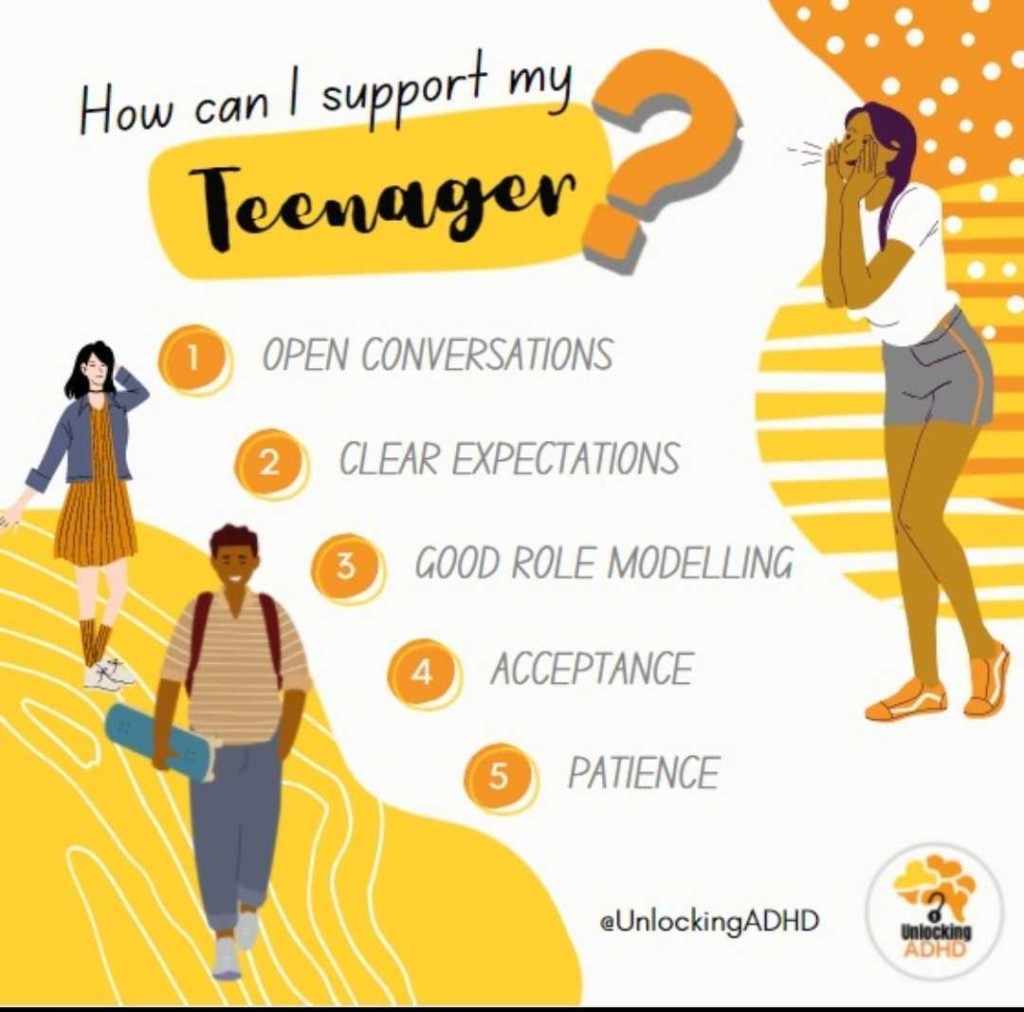
One of the most important things that parents can do for ADHD teens is to form a close relationship with them to see them through the rollercoaster teen years. Here are some ways to do this:

  • Speak openly with each other
  • Be supportive and accepting
  • Communicate clear and consistent expectations
  • Set a daily routine to minimise distractions
  • Work with teachers to ensure tasks are fulfilled
  • Discuss “what if” scenarios to rehearse responses with situations, e.g., bullying, negative peer pressure, etc.
  • Recognise important healthy peer relationships and do not be overly critical of certain friendships
  • Set social goals and come up with a reward system to encourage social interactions, especially if your teen is generally shy

If you like this article and find it helpful, please share this with your networks. Do consider donating to support us in our mission to empower ADHDers and their families to live life to the fullest so that we can continue to create more content that informs and equips the ADHD community – Please Donate To Support UA.

*DISCLAIMER: This information is provided for educational purposes only and does not constitute medical advice. Should you suspect that you have ADHD, consider seeking the advice of a trained mental health professional with any questions you may have about your condition.

Subscribe to our newsletter

  1. Making Sense of my Daughter’s ADHD Diagnosis
  2. Anxiety Disorders and ADHD
  3. Six Simple Steps to Support ADHDers in Class

Resources on ADHD

  • Adult ADHD Self-Assessment Tool
  • Understanding ADHD
  • Healthcare and Community Services
  • Support Groups
  • Online Resources
  • Contact Us (General Enquiries)
  • Contact Us (Counselling Services)

Follow us

Copyright © 2026 · Unlocking ADHD Ltd. All rights reserved. Terms | Privacy policy
Unlocking ADHD Ltd does not provide medical advice, diagnosis, or treatment. The material on this web site is provided for educational purposes only.

We use cookies on our website to give you the most relevant experience by remembering your preferences and repeat visits. By clicking “Accept All”, you consent to the use of ALL the cookies. However, you may visit "Cookie Settings" to provide a controlled consent.
Cookie SettingsAccept All
Manage consent

Privacy Overview

This website uses cookies to improve your experience while you navigate through the website. Out of these, the cookies that are categorized as necessary are stored on your browser as they are essential for the working of basic functionalities of the website. We also use third-party cookies that help us analyze and understand how you use this website. These cookies will be stored in your browser only with your consent. You also have the option to opt-out of these cookies. But opting out of some of these cookies may affect your browsing experience.
Necessary
Always Enabled
Necessary cookies are absolutely essential for the website to function properly. These cookies ensure basic functionalities and security features of the website, anonymously.
CookieDurationDescription
cookielawinfo-checkbox-analytics11 monthsThis cookie is set by GDPR Cookie Consent plugin. The cookie is used to store the user consent for the cookies in the category "Analytics".
cookielawinfo-checkbox-functional11 monthsThe cookie is set by GDPR cookie consent to record the user consent for the cookies in the category "Functional".
cookielawinfo-checkbox-necessary11 monthsThis cookie is set by GDPR Cookie Consent plugin. The cookies is used to store the user consent for the cookies in the category "Necessary".
cookielawinfo-checkbox-others11 monthsThis cookie is set by GDPR Cookie Consent plugin. The cookie is used to store the user consent for the cookies in the category "Other.
cookielawinfo-checkbox-performance11 monthsThis cookie is set by GDPR Cookie Consent plugin. The cookie is used to store the user consent for the cookies in the category "Performance".
viewed_cookie_policy11 monthsThe cookie is set by the GDPR Cookie Consent plugin and is used to store whether or not user has consented to the use of cookies. It does not store any personal data.
Functional
Functional cookies help to perform certain functionalities like sharing the content of the website on social media platforms, collect feedbacks, and other third-party features.
Performance
Performance cookies are used to understand and analyze the key performance indexes of the website which helps in delivering a better user experience for the visitors.
Analytics
Analytical cookies are used to understand how visitors interact with the website. These cookies help provide information on metrics the number of visitors, bounce rate, traffic source, etc.
Advertisement
Advertisement cookies are used to provide visitors with relevant ads and marketing campaigns. These cookies track visitors across websites and collect information to provide customized ads.
Others
Other uncategorized cookies are those that are being analyzed and have not been classified into a category as yet.
SAVE & ACCEPT

Daniel

This image has an empty alt attribute; its file name is logo-2-1.png
AMKFSC Community Services has a Psychological Services Unit (PSU) which has a team of clinical and counselling psychologists for children/youth and their parents. Core services include psychoeducational assessments (5 to 16 years old) for ADHD and other learning disabilities. They also offer group and individual psychotherapy. They only provide services to residents in their constituency.

Fees are $70 per one hour session. Psychoeducational testing ranges between $750 to $1,120 depending on the tests required.

Email: psureferral@amkfsc.org.sg.

Moonlake is the Founder of Unlocking ADHD. A community builder and multi-hyphenate, she runs to fat burn so that she can enjoy food with family and friends. She is still working on strengthening the brakes for her ADHD wiring…