


Unlocking ADHD writer Megan Tan shares her story on living with ADHD — with a little help from some friends.
It was past midnight, and I was packing for a school trip. The room looked like a tornado had hit. Clothes were strewn about the floor. Random toiletries were tossed carelessly about. Electronics sat in a tangled heap. And there, amidst all the chaos, was a small attempt at organisation—an abandoned, half-checked packing list.
Staring at the mess before me, I felt ashamed. I was a well-seasoned traveller. Why had I left it to the last minute, again? How should I even begin to disentangle this mess?
Anxiety seized me like a vice—what if I couldn’t finish packing? What if I got to my destination only to find that half the things I needed were missing? What if my inability to pack meant I was late, and everyone would be forced to wait for me? What if I angered everyone because I made them wait? Would my group be disappointed they had gotten such an incompetent leader? Should I even ask my parents for help? Would they yell at me for not being able to complete such a simple task?
I did the most logical thing I could think of in that situation. I burst into tears.
Eventually, I pulled myself together, and unearthed the abandoned packing list. Okay. First thing to pack: Clothes.
“Clothes”? What did that even mean? Was underwear also considered clothes? How many outfits should I bring? What colour? Which type? A fresh wave of frustration and anxiety set in.
Other items yielded similar questions. At one point, I may have balled up the list and thrown it at the wall. The luggage was packed many painful hours later, and I woke up the next morning sleep deprived and irritable.
I didn’t understand what was wrong with me. It wasn’t until three years later that I would receive answers in the form of a diagnosis – Attention Deficit Hyperactivity Disorder (ADHD), the Inattentive presentation.
There are three presentations of ADHD – Hyperactive, Inattentive and Combined. Having the Inattentive presentation means that I am less hyperactive, but present with other ADHD symptoms such as inattentiveness, forgetfulness, disorganization and others I will discuss later in in this piece. The term ADHD inattentive presentation was initially called ADD, or Attention Deficit Disorder, but that has since changed.
Ah, Gender
One of the reasons I went under the radar? My gender.
ADHD is notoriously underdiagnosed in women. According to ADDitude, a site dedicated to all things ADHD, women tend to be diagnosed with other disorders like depression (this was also the case for me) before they are diagnosed with ADHD. Additionally, girls tend to present as inattentive, rather than the stereotypical image of a boy bouncing off the walls.
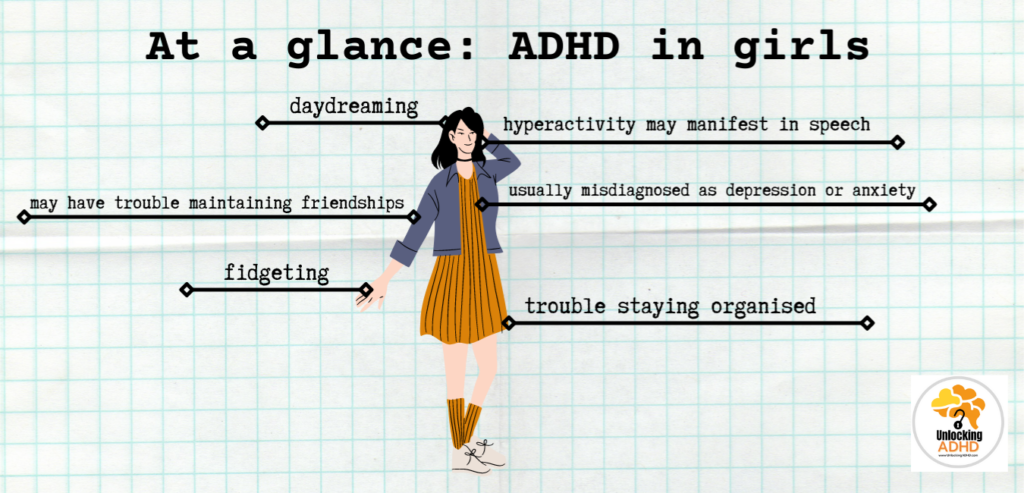
Dani Donovan, creator of the #neurodiversesquad hashtag and ADHD comic artist, said, “For me, hyperactivity was extreme talkativeness, I just have this bounding enthusiasm, energy, which is awesome. I like that part of my personality. But it can really be a lot for some people.”
According to Jessica McCabe of How to ADHD, a YouTube channel that teaches people with ADHD how to manage their symptoms, it is important to look out for social struggles when checking for ADHD in girls. Being talkative, interrupting others often, can lead to difficulties in making and maintaining friendships.
Executive is the Name, Dysfunction is the Game
Many people believe ADHD is an inability to pay attention, but it is far more complicated than that. It is, after all, a neurodevelopmental disorder affecting our frontal lobe. That means our “executive functions” like our ability to make decisions, regulate our emotions, plan, control our impulses and our social cognition — are affected.
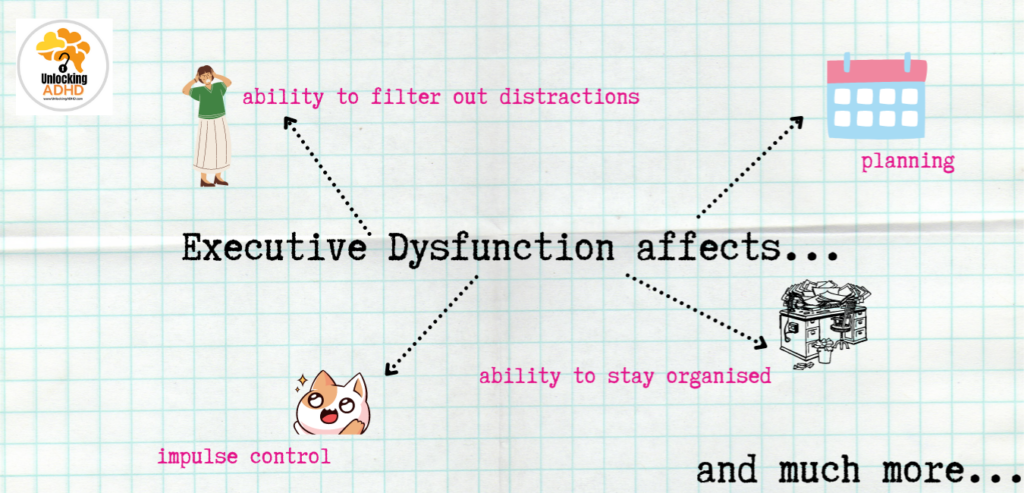
Sometimes I think the name ADHD should be changed to Executive Function Disorder, since that is what we struggle with the most. To the outside world, it might look like procrastination when we sit on the couch, staring into space instead of doing the laundry. What most people don’t see is the internal struggle as we try to force ourselves to do the thing. My friend, Yee Shin, who also has ADHD, shared with me, “My parents always got mad at me for not immediately obeying their orders to do things around the house. I knew I wasn’t inherently disobedient, but as with the homework, I was struggling to understand why I just found it so difficult to do things on command.”
The inability to regulate executive functioning is affected by the brain’s reward system. In ADHD brains, the brain doesn’t produce enough of the “happy chemicals”, like dopamine, when we finish a task. As a result, people with ADHD find it difficult to do things like chores. It’s the reason why I couldn’t pack that night, despite being a well-seasoned traveller. I wasn’t able to plan or prioritise, skills that should have come easily to most people my age.
What happens when you can’t get things done? People stop counting on you. They start labelling you with names like lazy or unmotivated or flaky or failure. When you also struggle with regulating emotion, that can become a big problem.
Feelings, so many feelings
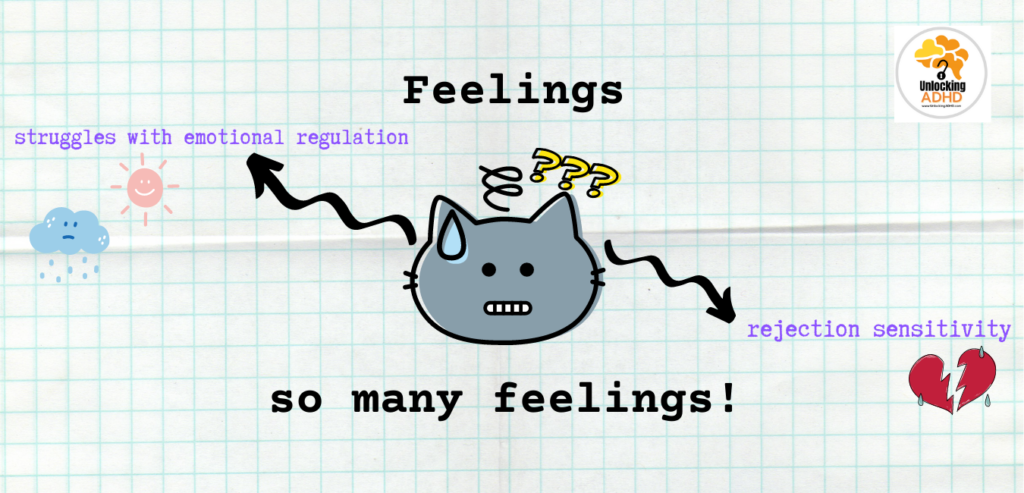
Dani Donovan describes emotional dysregulation as “spinning out of control”. We’ve all had times when we felt like that, but what if that was your whole life? Emotional dysregulation has always been my biggest problem. I always feel like I’m spiralling, swept away by an ocean of emotion with no ground to stand on. Couple that with poor impulse control, and you have a perfect storm. My social life, for the longest time, was in shambles. I bristled at the slightest comment, lashed out at friends instead of talking calmly and said many things I regret.
It’s not just social life that’s been affected. Dani shared that it would affect her professional life, too. While she’s now self-employed, in the past, bosses would call her in for performance reviews. Often, she would try to keep it together, but certain criticism would bring on the waterworks. “And that’s embarrassing, to cry when a boss is criticizing you,” she said.
It’s also important to address an aspect of ADHD most people unknowingly contribute to – rejection sensitivity. When your emotions already feel disproportionately intense, rejection cuts like a knife. While seeking help for depression I started therapy. About 30 minutes into our first session, my therapist asked, “Are you afraid of rejection?”
It was like she’d pulled a trigger. I remembered countless instances where I would wait, anxious, wondering why my friend took one minute longer than yesterday to respond to my text. During group projects, I felt hesitant at adding my voice, worried my ideas would be rejected, often choosing to go with the group even if I didn’t agree.
Of course, it doesn’t help that growing up with ADHD, you often feel like you don’t fit in. Struggling with attention regulation means we don’t always listen when someone talks. Our poor impulse control means we tend to interrupt, or not think before we speak. Adults in our lives criticise us for our behaviours without questioning why. It’s no wonder ADHD kids develop into adults who are sensitive to rejection.
“How it feels a lot of the time is over sensitivity to people, people’s comments, people’s tone, people’s body language, people’s facial expressions, I read into everything and get anxious about stuff,” Dani shared.
It can turn into a chain reaction. Our executive dysfunction makes everyday life difficult. Someone sees this and criticises us for it. Our rejection sensitivity kicks in. Because we can’t regulate our emotions as well, the feeling becomes all encompassing. We lash out, hurt, and say something we don’t mean. Wash, rinse and repeat. It’s exhausting and often hurts our self-esteem, yet we continue to be judged by those not privy to our struggles.
Ever tried losing weight?
Dani uses the analogy of losing weight to illustrate this. We all know that losing weight entails exercising and healthy eating. We might even succeed at doing this for a while. But eventually, that motivation fades. We know we should exercise. We know we should be putting on our sportswear and heading out, but we can’t seem to find the motivation, so we sit on the couch, berating ourselves for it. “We’re just as frustrated with ourselves as you are,” Dani says.
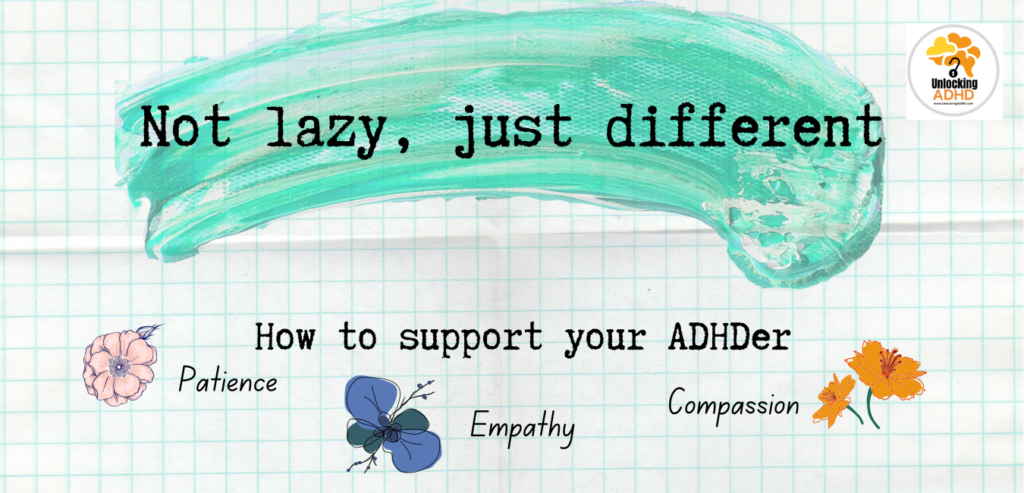
So, the next time you want to judge someone for being “unmotivated”, take a second to think. Yee Shin says, “Be patient and understanding. That’s the most important of all. Our brains work differently than yours do; that doesn’t mean we’re inherently bad or lazy.”
This article was originally published on Edition Three of Farrago Magazine in 2021.
[If you liked this story and found it helpful, please SHARE it. For more personal stories about ADHDers, please click here.]




Leave a Reply